
About Paratriathlon
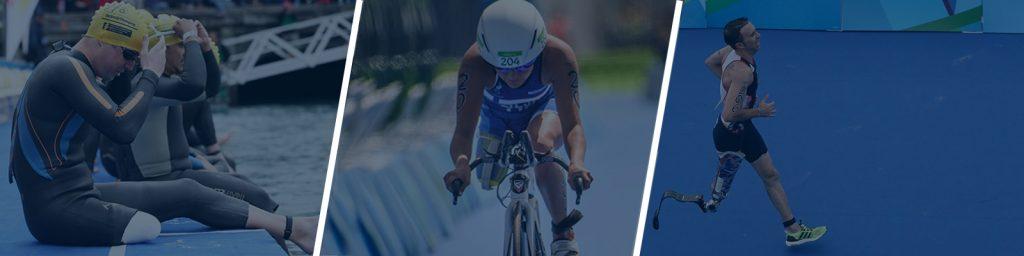
Para-triathlon is a multidisciplinary endurance race consisting of 750m swim, 20km cycle and 5km run. Athletes compete in categories based on specific physical and visual impairments. Para-triathletes may use handcycles, tandem bicycles or racing wheelchairs. Indian para-triathletes compete in World Championships, and the Indian Triathlon Federation is affiliated with the Paralympic Committee of India.
Events / Disciplines
Sprint Distance Triathlon — 750m swim, 20km bike, 5km run. (Individual and team entry options)
Classifications
Who is eligible for Para triathlon?
Athletes with a vision impairment or a physical impairment.
Classification of athletes
Classification provides a structure for competition. Athletes competing in Para triathlon have an impairment that leads to a competitive disadvantage. Consequently, the purpose of classification is to minimise the impact of impairments on sport performance and to ensure that the success of an athlete is determined by skill, fitness, power, endurance, tactical ability and mental focus.
What are the classes?
A sport class is a category which groups athletes depending on how much their impairment impacts performance in their sport.
There Are Nine Sport Classes in Paratriathlon
- PTWC1Most impaired wheelchair users
Athletes must use a recumbent handcycle on the bike course and a racing wheelchair on the run segment. Includes athletes with comparable activity limitation and an impairment of, but not limited to: muscle power, limb deficiency, hypertonia, ataxia or athetosis.
- PTWC2Least impaired wheelchair users
Athletes must use a recumbent handcycle on the bike course and a racing wheelchair on the run segment. Includes athletes with comparable activity limitation and an impairment of, but not limited to: muscle power, limb deficiency, hypertonia, ataxia or athetosis.
- PTS2Severe impairments
In both bike and run segments, amputee athletes may use approved prosthesis or other supportive devices. Includes athletes with comparable activity limitation and an impairment of, but not limited to, limb deficiency, hypertonia, ataxia and or athetosis, impaired muscle power or range of movement.
- PTS3Significant impairments
In both bike and run segments, amputee athletes may use approved prosthesis or other supportive devices. Includes athletes with comparable activity limitation and an impairment of, but not limited to, limb deficiency, hypertonia, ataxia and or athetosis, impaired muscle power or range of movement.
- PTS4Moderate impairments
In both bike and run segments, amputee athletes may use approved prosthesis or other supportive devices. Includes athletes with comparable activity limitation and an impairment of, but not limited to, limb deficiency, hypertonia, ataxia and or athetosis, impaired muscle power or range of movement.
- PTS5Mild impairments
In both bike and run segments, amputee athletes may use approved prosthesis or other supportive devices. Includes athletes with comparable activity limitation and an impairment of, but not limited to, limb deficiency, hypertonia, ataxia and or athetosis, impaired muscle power or range of movement.
- PTVI1Total blindness
Includes athletes who are totally blind, from no light perception in either eye, to some light perception. One guide is mandatory throughout the race. Must ride a tandem during the bike segment. A guide from the same nationality and gender is mandatory throughout the race.
- PTVI2Severe partial sight
Includes athletes who are more severe partially sighted athletes. One guide is mandatory throughout the race. Must ride a tandem during the bike segment. A guide from the same nationality and gender is mandatory throughout the race.
- PTVI3Less severe partial sight
Includes athletes who are less severe partially sighted athletes. One guide is mandatory throughout the race. Must ride a tandem during the bike segment. A guide from the same nationality and gender is mandatory throughout the race.
Both PTWC1 and PTWC2 classes compete in the same PTWC Medal Event. All ambulant classes (PTS2–PTS5) compete in their own medal event, and the three visually impaired classes (PTVI1, PTVI2 and PTVI3) compete in the PTVI Medal Event.
Please visit World Triathlon to find out more about the classification process — triathlon.org/paratriathlon.
How Do I Get a Classification?
- Click here to get your ITF Para Triathlon membership.
- Click to view ITF Para Triathlon registered members.
- Contact indiantriathlonfederation@gmail.com or harish.prasad@triathlonindia.com for more queries.